
Republican-Era Masterpiece Reemerges
Wang Qi’s Monumental Famille-Rose Moon Flask Unveiled
One Unique Treasure, One Chapter of History, One Testament of Loyalty — A Gift of Blessing Revived After Nearly a Century
Introduction
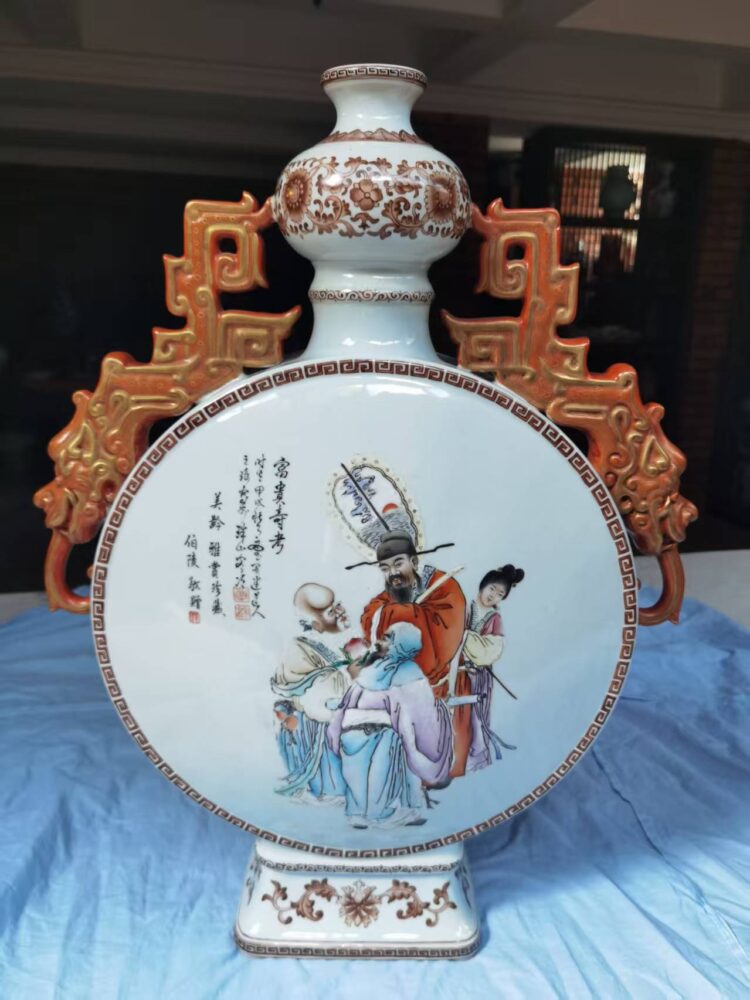
Toronto, Canada — September 2025 — The art and antiques world is abuzz with the public unveiling of a singular masterpiece: a monumental famille-rose moon flask by Wang Qi, one of the celebrated “Eight Friends of Zhushan.” This late-period work by Wang Qi stands an impressive 63 cm tall, with finely painted scenes on both sides, combining monumental form, exquisite craftsmanship, and profound cultural significance. It is a perfect convergence of ceramic artistry and the political and social history of Republican-era China.
Historical Background: One Moon Flask, One Story
This flask was commissioned in the early 1930s by Xue Yue (style name Boling), then Commandant of the Lushan Military Officer Training Corps, and presented as a gift to Madame Soong Mei-ling for her collection at the historic Meilu Villa. Built in 1903 and later transferred to Soong Mei-ling in 1934, Meilu became the summer residence of Chiang Kai-shek and Soong Mei-ling in 1933. This moon flask is thus not merely a work of art, but a witness to the political life and social history of the Republican period.
The renowned collector “Iron Horse Hermit” praised this piece in his Chenghongtang Notes as a “marvelous rarity” and identified it as a late masterpiece by Wang Qi (1884–1937). As a leading figure among the Eight Friends of Zhushan, Wang Qi is celebrated for his refined famille-rose technique, which bridged tradition and modernity and remains highly sought after by collectors worldwide.
1933: Political Context and Gift-Giving
The year 1933 marked a pivotal moment for the Nationalist Government. Following the Northern Expedition and successive military campaigns, Chiang Kai-shek had effectively unified most of China and consolidated his power as head of state, ushering in a relatively stable period known as the “Nanjing Decade.” Domestically, Chiang was reforming the fiscal system, initiating the New Life Movement, and working toward social modernization; internationally, he was countering Japanese aggression while seeking diplomatic recognition and support.
At this time, Soong Mei-ling had become the Republic’s most influential First Lady and the international face of Chiang’s government. With her American education and fluent English, she served as a key diplomatic bridge, actively participating in receptions, public addresses, and promoting women’s education and social welfare.
Xue Yue’s Intention and the Inscription
Xue Yue understood that winning the Chairman’s trust required more than military achievements — it demanded sensitivity to relationships and gestures. By commissioning a monumental work from Wang Qi and presenting it to Madame Chiang rather than Chiang himself, he demonstrated both political acumen and personal tact:
-
Commissioning a Masterpiece: Wang Qi was the foremost famille-rose painter of his era; a personal commission signaled the utmost respect and cultural sophistication.
-
“To the Lady Rather than the Leader”: A gift to the First Lady could please Chiang without appearing overly calculating, making the gesture warmer and more gracious.
-
A Declaration of Loyalty: By presenting it through Madame Chiang, Xue Yue subtly expressed his devotion to Chiang Kai-shek and his alignment with the government’s vision, paving the way for future trust and advancement.
On the reverse of the flask is inscribed a quatrain:
“This great merit crowns a statesman of the dynasty’s revival,
Master of strategy and guardian of peace,
His name resounds across China, his station as mentor and protector,
Enjoying Heaven’s threefold blessings — wealth, honor, and long life.”
These four lines are both eulogy and blessing — praising the “elder of national revival,” praying for peace and longevity, and reflecting Xue Yue’s own heart:
-
Allegory of Loyalty: By invoking Tang general Guo Ziyi, a hero of dynastic restoration, Xue likens Chiang to a ruler who restored the nation and casts himself as the loyal general who would safeguard it.
-
Blessing as Political Wish: The final line links personal longevity to national prosperity, tying Madame Chiang’s well-being to the stability of the state.
-
Aspirations for the Future: “Threefold blessings” (sons, fortune, and longevity) is both a wish for the nation and a subtle prayer for Xue Yue’s own career path to flourish.
-
Elegance and Deliberation: The verse is refined and meticulously crafted, elevating the gift from a mere object to a vehicle of culture, diplomacy, and sentiment.
Thus, this moon flask is not just a vessel — it is a “silent memorial,” a piece of political theater and personal devotion fused into porcelain.
Dual-Sided Narrative: A Complete Story of Longevity
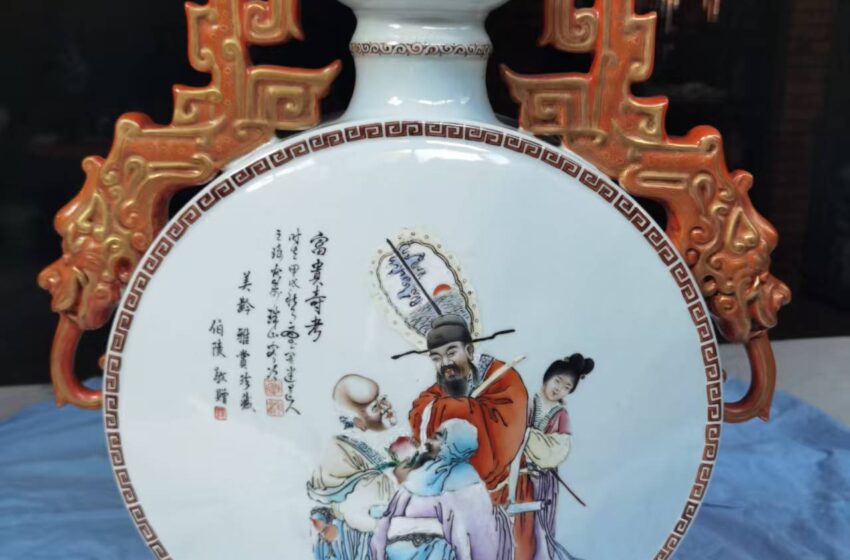
This moon flask presents a two-sided pictorial narrative, forming a complete and symbolic blessing for longevity:
-
Obverse: “Three Stars Greeting Longevity”
The auspicious trio of Fu, Lu, and Shou (Fortune, Prosperity, and Longevity) gather to convey their blessings. The scene is elegant and serene, the figures finely detailed and gently colored — a signature of Wang Qi’s mature famille-rose style. -
Reverse: “Guo Ziyi’s Birthday Celebration”
The composition depicts the historic banquet where Tang general Guo Ziyi celebrated his seventieth birthday, attended by court officials and family. The scene conveys abundance, harmony, and national prosperity. Coupled with the inscription, it elevates the work into a prayer for both personal longevity and a flourishing nation.
Together, the two sides mirror each other — heaven and earth, divine blessing and human celebration — symbolizing “heaven and man in harmony” and making this one of Wang Qi’s most accomplished late works.
Cultural Significance of the Guo Ziyi Motif
The subject of Guo Ziyi’s birthday celebration has been depicted for centuries in paintings, prints, and porcelain. Guo Ziyi (697–781) was a Tang dynasty general whose military exploits and loyalty saved the dynasty during the An Lushan Rebellion. His seventieth birthday became legendary for the sight of “descendants filling the hall,” and for a famous episode in which he mediated a marital dispute involving his son and the Princess Shengping — an enduring parable of virtue, humility, and family harmony.
By including this theme, the moon flask links the idea of long life with loyal service and dynastic stability — a perfect symbolic compliment to the front panel’s celestial blessing.
Form and Craftsmanship: A “Palatial Hybrid”
This moon flask is not of a single conventional type, but a “hybrid form” synthesizing three classical vessel types, a hallmark of high-level Republican-era commissions:
-
Upper Section: Lantern-Shaped “Treasure Vase” Neck
The gently swollen neck with inward-curved rim resembles the imperial baoping (treasure vase), symbolizing “peace and safety.” It is encircled with iron-red and gilt baoxianghua floral scrolls, reinforcing the theme of longevity and blessing. -
Central Body: Classic Moon Flask Profile
The wide, flat body with generous shoulder is ideal for double-sided figural painting. At 63 cm tall, this is a monumental example — technically difficult to shape and fire without warping, making its survival exceedingly rare. -
Lower Section: Square Pedestal Foot
The square pedestal transforms the vessel from a simple flask into a “ceremonial centerpiece,” ideal for hall display in grand settings like Meilu’s main hall. -
Shoulder Handles: Coral-Red Dragon Handles
Instead of the usual flat strap handles, the artist used sculptural “dragon handles” in coral red with gilt highlights — adding vertical tension, symmetry, and a courtly presence. -
Harmonious Decoration System
The rim and foot are both framed with iron-red baoxianghua motifs, visually crowning and grounding the vessel, unifying its composition into a symbolic cycle of peace, prosperity, and longevity.
Technical Difficulty and Value
-
Monumental Firing: The large flat body required multiple stages of molding, trimming, glazing, and firing — each step with high risk of collapse or warping.
-
Complex Assembly: Multiple structural components — neck, handles, body, and base — had to align perfectly on a vertical axis.
-
Multiple Low-Fire Enamels: Iron-red, gilding, and famille-rose colors required successive firings at precise temperatures, yet the hues remain harmonious and brilliant.
-
Iconographic Integration: The pairing of the “Three Stars” and “Guo Ziyi Celebration” themes within this hybrid form creates a unified narrative of blessing, loyalty, and statecraft.
Scholarly and Market Significance
-
Artistic Value: A late-period masterpiece by Wang Qi, significant for the study of modern Jingdezhen enamel painting.
-
Rarity: A unique surviving example — monumental in size, with double-sided figural decoration, and preserved in excellent condition.
-
Historical Provenance: Directly tied to Madame Chiang Kai-shek, Meilu Villa, and Xue Yue, making it a key artifact of Republican-era politics and culture.
-
Documented Lineage: Clear inscriptions, seals, and recorded notes confirm its provenance.
Significance of Named Dedications
The flask’s inscription explicitly records both the recipient (“For Madame Mei-ling’s Elegant Appreciation and Collection”) and the donor (“Respectfully Presented by Boling”). Such clear dedication inscriptions dramatically enhance both scholarly and market value:
-
Uniqueness and Narrative: The gift and recipient are named on the object itself, turning it into a historical document as well as a work of art.
-
Academic Value: Provides tangible evidence for the study of gift culture, political networks, and elite taste in the Republican era.
-
Market Premium: Works bearing specific names of political or historical figures command significantly higher prices at international auctions compared to unsigned or generically inscribed pieces.
Literary Conclusion
This moon flask is at once a gift of longevity and a testament of loyalty. It paints “fortune, prosperity, and long life” across its surface while embedding the heart of a devoted general within its glaze. From the halls of Meilu in 1933 to its reappearance today, it carries nearly a century of history and emotion, inviting viewers back into an era where ceremony, politics, and personal sentiment were fused in porcelain. It is not merely a vessel, but a three-dimensional chapter of history — a “memorial without words” that still speaks across time.